
June 3, 2026
Bad Data, Bad AI: Fix Your Data Before You Build
Bad data pipelines can turn million-dollar AI investments into business-damaging disasters. Here are the costly mistakes that corrupt AI models and how to avoid them.
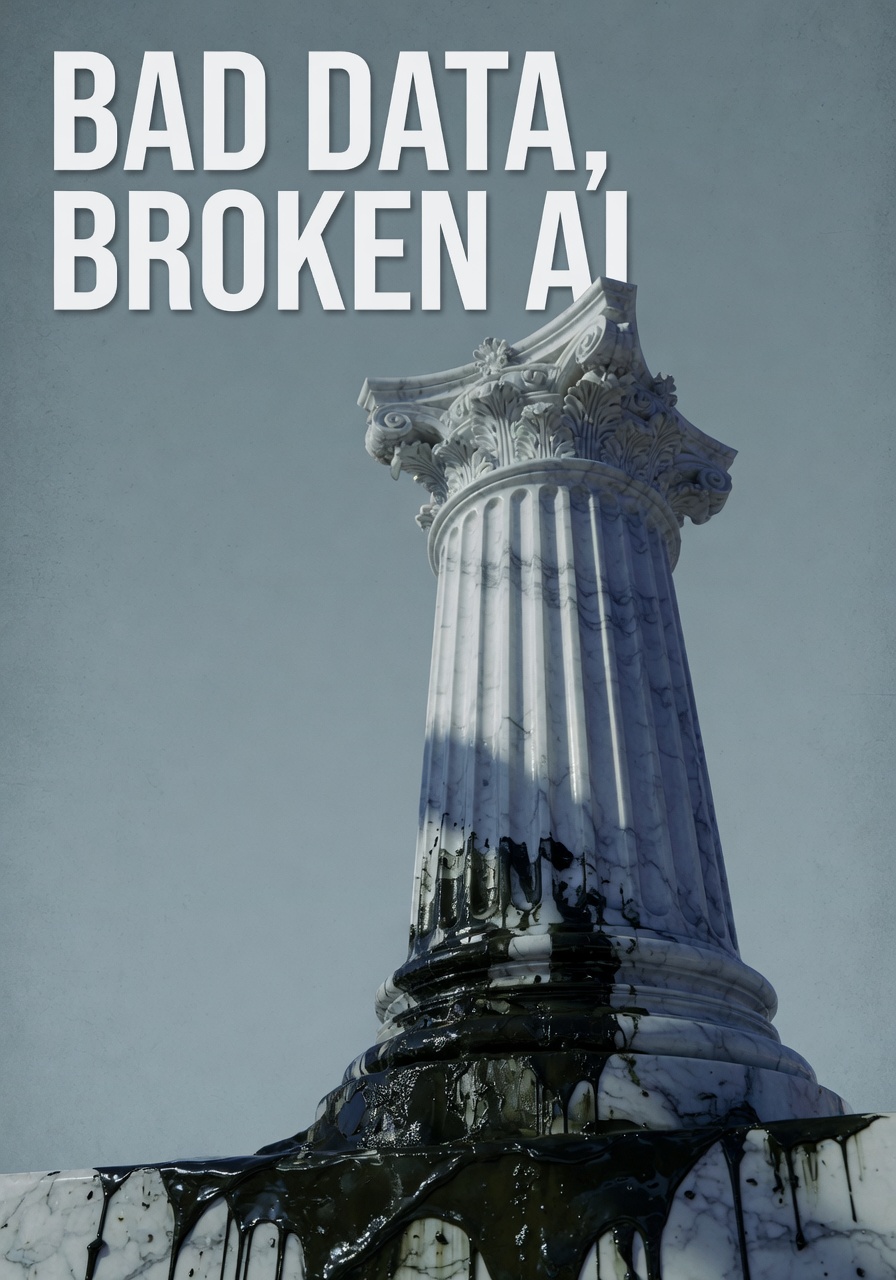
The phone call came at 3 AM. A Fortune 500 retailer's head of AI was watching their recommendation engine suggest winter coats to customers in Miami and beach umbrellas to shoppers in Minnesota. Six months of development. $2.3 million invested. And their AI was actively driving customers away because nobody caught the timestamp corruption that had been feeding the model weather data from the wrong time zones.
Your AI is only as good as your data pipeline. When that pipeline breaks, it doesn't just waste money—it teaches your AI to make decisions that can destroy your business.
After auditing over 200 AI implementations, I've seen the same data pipeline disasters repeat like clockwork. Here are the mistakes that turned million-dollar AI investments into expensive lessons in humility.
Mistake #1: The Silent Data Drift That Killed Customer Trust
What Went Wrong: A financial services company built a fraud detection model using historical transaction data. The model performed beautifully in testing—99.2% accuracy. But three months after deployment, legitimate customer transactions were being flagged as fraud at alarming rates. The culprit? Their data pipeline was silently dropping records with null values, and post-COVID spending patterns had created more null fields than their historical data ever contained.
The Cost: $1.8M in lost revenue from blocked legitimate transactions, plus $400K in emergency fixes and another $200K to retrain the model. But the real damage was 12,000 angry customers who couldn't use their cards during holiday shopping.
How to Avoid It: Implement continuous data quality monitoring that alerts you the moment your incoming data distribution shifts from your training data. Set up automated checks for null rates, value ranges, and data types on every field your model touches.
Reality Check: Studies show that 85% of AI projects fail due to data quality issues, yet only 23% of companies have automated data validation in their ML pipelines.
Mistake #2: Training on Tomorrow's News
What Went Wrong: An e-commerce company's demand forecasting model was showing incredible accuracy—until they realized it was accidentally using future sales data to predict future sales. Their data engineer had joined tables using event_timestamp instead of created_timestamp, creating a time leak that made their model clairvoyant in testing and useless in production.
The Cost: $3.2M in excess inventory purchases based on inflated demand predictions. When the model's real-world accuracy dropped to worse than random, they were stuck with warehouses full of products nobody wanted.
How to Avoid It: Implement strict temporal validation in your data pipeline. Every feature engineering step should have time-based unit tests. Use point-in-time correctness checks to ensure your training data only includes information that would have been available at prediction time.
Reality Check: Time leakage is the #1 cause of models that work in development but fail in production. It's also the hardest bug to catch because the model performance looks too good to be true—which it is.
Mistake #3: The Poisoned Well Syndrome
What Went Wrong: A healthcare AI startup spent 18 months building a diagnostic model using data from multiple hospitals. They were months away from launch when they discovered that one hospital had been systematically miscoding diagnoses to maximize insurance reimbursements. That corrupted data had taught their AI to perpetuate billing fraud patterns instead of making accurate diagnoses.
The Cost: Complete restart. $4.1M in development costs down the drain, plus another year of development to rebuild with clean data. Three key investors pulled out, and the company barely survived the setback.
How to Avoid It: Implement data source validation and anomaly detection at the source level. Build lineage tracking so you can trace every prediction back to its source data. When something looks too good (or too bad) to be true in one data source, investigate before it contaminates your entire model.
Reality Check: The AI research community has documented cases where single corrupted data sources can flip model predictions with as little as 0.1% of training data. Your model will learn from bad examples just as eagerly as good ones.
Mistake #4: Feature Store Frankenstein
What Went Wrong: A logistics company built an elaborate feature store to power multiple AI models. Different teams were creating features with the same names but different definitions. "Customer_value" meant lifetime revenue to the marketing team, current month revenue to sales, and profit margin to finance. Their route optimization AI was making decisions using a Frankenstein combination of mismatched metrics.
The Cost: $800K in increased fuel costs from suboptimal routes, plus six months of data team time untangling the feature naming mess. Two senior data scientists quit in frustration, taking their tribal knowledge with them.
How to Avoid It: Establish feature governance from day one. Every feature needs an owner, a clear definition, and validation rules. Use feature registries with strict naming conventions and automated lineage tracking. Make feature schema changes require approval, just like code changes.
Reality Check: Feature stores can accelerate AI development by 3-5x when done right, but they become technical debt multipliers when governance is an afterthought.
Mistake #5: The Pipeline That Lied
What Went Wrong: A insurance company's pricing model was performing well until they noticed their loss ratios climbing steadily. The investigation revealed their data pipeline was handling missing values by forward-filling the last known value—but only during batch processing. In real-time scoring, missing values defaulted to zero. The model had learned that certain risk factors were always present, when in reality, they were often missing.
The Cost: $2.7M in underpriced policies over eight months. They had to reprice thousands of policies and eat the losses on policies already sold. The actuarial team lost credibility with the board, and regulatory auditors started asking uncomfortable questions.
How to Avoid It: Your training pipeline and serving pipeline must handle data identically. Use the same code libraries, the same missing value strategies, and the same feature transformations. Build integration tests that feed identical data through both pipelines and verify identical outputs.
Reality Check: Training/serving skew is responsible for 37% of production AI failures, yet most teams don't test for it until something goes wrong in production.
Our Approach: Pipeline Paranoia That Pays Off
At Renga Technologies, we've seen enough data pipeline disasters to develop what we call "pipeline paranoia"—the healthy fear that drives bulletproof data practices:
Data Quality Gates: We build validation checkpoints at every stage of your pipeline. Data doesn't move forward until it passes quality, freshness, and consistency checks.
Shadow Mode Testing: Before any pipeline changes hit production, we run new logic alongside existing systems to catch discrepancies before they corrupt your models.
Lineage-First Architecture: Every data point can be traced from raw input to model prediction. When something goes wrong, we know exactly where to look.
Pipeline Twins: Your training and serving pipelines share the same core logic, eliminating training/serving skew by design.
We've helped 50+ companies avoid these pipeline disasters. The companies that invest in bulletproof data pipelines upfront spend 60% less on model maintenance and see 3x faster time-to-production for new models.
Because in AI, garbage in doesn't just mean garbage out—it means expensive, embarrassing, business-damaging garbage that your model will confidently defend as correct.
Don't let bad data destroy your AI investment. The cost of getting data pipelines right is a fraction of the cost of getting them wrong.
Have a workflow like this?
Tell us which job you want off your team's plate. You'll get the build, a fixed price and a launch date within 48 hours.